Sudowrite vs. ChatGPT: Why Generic AI Fails at Fiction
Sudowrite vs ChatGPT for Fiction Writing (2026): The Honest Comparison
"Why should I pay for Sudowrite when ChatGPT is free?"
If you are an author or screenwriter looking into AI writing tools in 2026, this is almost certainly the first question you asked. It is a completely fair one. ChatGPT is a technological marvel — fantastic for summarizing documents, writing emails, answering research questions, and generating code.
But if you have ever tried to write a full 80,000-word novel with ChatGPT, you have likely run into the same wall every fiction writer hits. The characters sound flat. The plot forgets itself by chapter ten. The prose sounds like it was written by a corporate PR department. And the moment your story gets even slightly dark or intense, ChatGPT starts lecturing you about content guidelines.
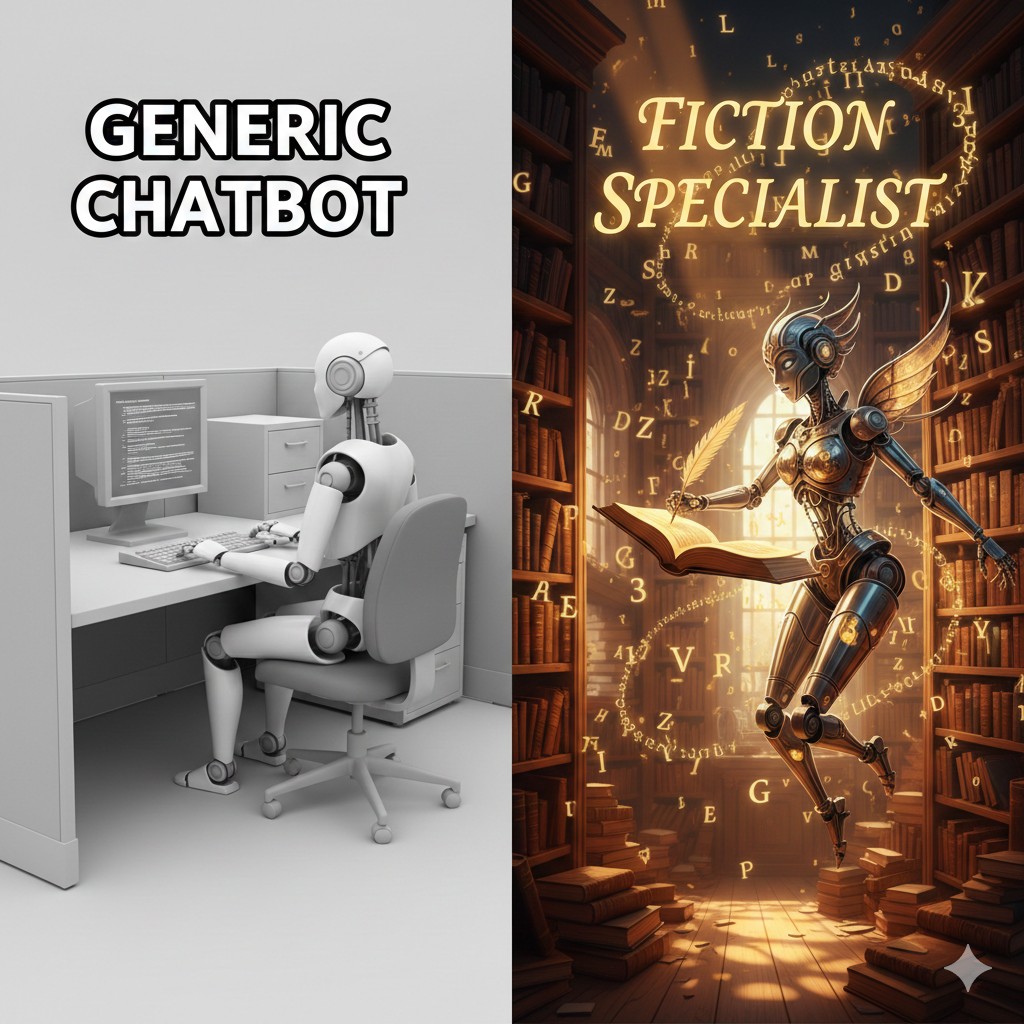
Here is the core truth: ChatGPT is a generalist assistant. Sudowrite is a specialist co-author. They are not actually competing for the same job.
This comparison breaks down exactly where each tool wins, where it fails, and which one deserves your money if finishing your manuscript is the goal.
At a Glance: Core Differences
| ChatGPT Plus | Sudowrite | |
|---|---|---|
| Primary design | Business, coding, research, general tasks | Fiction, novels, screenplays |
| Content filters | Strict — refuses dark themes, conflict, mature scenes | Lenient — allows dark and mature themes within legal limits |
| Long-term memory | Poor — context drift after several chapters | Excellent — Story Bible maintains consistency across 100k+ words |
| Prose quality | Generic "AI cadence," tells rather than shows | Customizable, literary, sensory-driven output |
| Interface | Blank chat box | Dedicated manuscript workspace with structured tools |
| Specialised fiction tools | None | Story Engine, Describe, Rewrite, Brainstorm, Visualizer |
| Starting price | $20/month (Plus) | ~$19/month (Hobbyist) |
| Free trial | ✅ Limited free tier | ✅ Credit-based trial, no credit card required |
| Best for | Brainstorming, research, outlines | Drafting, prose quality, long-form consistency |
Round 1: Content Freedom — The HR Manager Problem
Conflict is the engine of every good story. Without violence, tension, dark themes, or genuine emotional intensity, fiction becomes a corporate memo. The single biggest frustration fiction writers have with ChatGPT is what the writing community calls the "HR Manager Problem."
ChatGPT is designed by OpenAI to be safe for enterprise and consumer use at massive scale. That means any scene that involves real conflict — a gritty fight, a villain doing something genuinely evil, a psychologically complex trauma scene — frequently triggers a refusal or gets sanitized into something toothless. It treats your fictional story as if it were a real-world request, breaking your creative flow at exactly the moment you need momentum.
Sudowrite was built by fiction writers for fiction writers. The platform understands that conflict, darkness, and moral complexity are not bugs in storytelling — they are the entire point. Its models are tuned specifically for creative fiction, which means you can write your thriller villain, your romance scene, or your grimdark battle without being interrupted by a content warning.
Winner: Sudowrite — no contest for writers who need creative freedom.
Round 2: Long-Term Memory — The Goldfish Problem
Writing a novel is not a single session. It is dozens of sessions, hundreds of scenes, and months of work. This is where the difference between a generalist AI and a specialist tool becomes impossible to ignore.
ChatGPT operates on a context window. Paste Chapter 1 and it remembers everything perfectly. By Chapter 10, it has forgotten your protagonist's eye colour. By Chapter 20, characters who died in Act 1 reappear with no explanation. Plot threads you seeded in the opening chapters simply vanish. You spend as much time reminding the AI of your story's rules as you do actually writing.
Sudowrite solves this with its Story Bible — a structured database that lives alongside your manuscript. Before you start writing, you input your characters (personality, appearance, history), your world-building rules, your magic system, your locations, and your genre conventions. Every time Sudowrite generates a new scene, it cross-references the Story Bible. Chapter 40 is as consistent as Chapter 1. Characters behave according to their established motivations. Plot threads stay intact.
For anyone writing anything longer than a short story, this is the most practically important difference on this list.
Winner: Sudowrite — Story Bible is a game-changer for long-form fiction.
Round 3: Prose Quality — Show, Don't Tell
The most recognisable flaw in AI-generated fiction is what editors call "telling" — the AI summarises an emotion rather than creating it through sensory detail and action.
ChatGPT asked to describe a creepy forest typically produces: "The forest was dark and ominous, evoking a profound sense of fear and mystery, a testament to nature's power." It tells you how to feel. It relies on adjectives and abstractions rather than concrete sensory experience. After a few pages, the "AI cadence" becomes unmistakable — a flat, slightly formal, curiously emotionless voice that no amount of prompting fully eliminates.
Sudowrite has a dedicated Describe feature built into the manuscript editor. Highlight any noun — forest, dungeon, first kiss, thunderstorm — and Sudowrite generates sensory descriptions broken into sight, smell, sound, taste, and touch:
- Sight: "Emerald canopies filtering dappled, sickly-yellow sunlight between skeletal branches..."
- Smell: "The suffocating scent of damp pine needles and slowly decaying loam..."
- Sound: "The sharp, echoing crack of a dry twig underfoot, then absolute silence..."
You select the details that fit your scene, weave them into your prose, and the result reads like a human writer who paid attention in a creative writing workshop. The Rewrite feature takes it further — highlight any flat paragraph and instruct Sudowrite to make it "more tense," "more melancholic," or "faster-paced," and it rewrites with that emotional direction.
Winner: Sudowrite — sensory prose output is significantly stronger.
Round 4: Interface and Workflow
A tool you actually enjoy using gets used. A tool that fights your workflow gets abandoned halfway through chapter three.
ChatGPT gives you a blank chat box. There is no manuscript view, no chapter structure, no character database, and no way to organise your project within the tool itself. You are essentially copying and pasting between ChatGPT and a separate word processor for the entire duration of your novel. It works — but it is not designed for writers.
Sudowrite is a purpose-built manuscript workspace. Your chapters are organised in a sidebar. Your Story Bible is always accessible. The toolbar contains your writing tools — Describe, Rewrite, Brainstorm, Expand — exactly where you need them as you write. The Visualizer generates AI character art directly from your descriptions to keep you inspired. The Plugin Gallery adds community-built tools for specific genres and workflows.
It feels like a writing environment. ChatGPT feels like a chat application.
Winner: Sudowrite — designed for writers from the ground up.
Round 5: Pricing and Value
This is where ChatGPT makes its strongest argument.
ChatGPT is free at the basic tier and $20/month for Plus, which adds GPT-4o access, faster responses, and image generation. For writers using it as a brainstorming tool or research assistant alongside their main writing workflow, the free version is genuinely useful.
Sudowrite is a paid product from the start, with a credit-based free trial to test the platform:
| Plan | Price | Best for |
|---|---|---|
| Free trial | $0 | Test the Story Bible and generate your first scenes |
| Hobbyist | ~$19/month | Casual writers and short stories |
| Professional | ~$29/month | Most authors — the recommended plan |
| Max | ~$59/month | Full-time authors writing multiple books per year |
The Professional plan at ~$29/month is where most serious novelists land. The credit allowance covers heavy Story Engine use without hitting a wall mid-chapter.
Is $29/month worth it compared to free? If you are writing a novel you intend to publish, yes. The hours saved fighting ChatGPT's filters, reminding it of your plot, and editing out the AI cadence far exceed the subscription cost within the first month of serious writing.
Winner: ChatGPT on price. Sudowrite on value for serious fiction writers.
The Pro Workflow: Use Both
The most efficient approach for most authors is not choosing one — it is using each tool for what it does best.
- Brainstorming (ChatGPT) — Use the free version or the voice mode on your phone during walks to bounce high-level plot ideas around, generate character name options, or work through a story problem conversationally. ChatGPT is excellent at this.
- Structuring (ChatGPT or Plottr) — Rough outline, three-act structure, chapter breakdown. Keep it in ChatGPT or move to Plottr for visual story mapping.
- Drafting and prose (Sudowrite) — Move your outline into Sudowrite's Story Bible and let the Story Engine handle the actual writing. Scene by scene, chapter by chapter, with full narrative consistency.
- Editing — Export to your word processor, apply your human voice, and publish.
This hybrid approach gives you the cost efficiency of ChatGPT for high-level work and the prose quality and consistency of Sudowrite for the manuscript itself.
Frequently Asked Questions
Can I write a full novel using only ChatGPT? Technically yes, but it is exhausting in practice. You will need long, detailed prompts for every scene, constant reminders about your characters and plot, and heavy editing to remove the AI cadence from the final prose. Many authors start with ChatGPT and switch to Sudowrite after hitting the consistency wall around chapter five.
Do I own the copyright to stories written with Sudowrite? Yes. Sudowrite's terms of service are clear that you retain 100% of the commercial rights to any content you create and refine on the platform. You can publish, sell, and monetize freely.
Is Sudowrite good for screenwriting as well as novels? Yes. The Story Engine and dialogue tools work well for screenplay structure. For dedicated screenwriting formatting, pair Sudowrite with a formatting tool — but for the creative generation and character consistency, it handles both formats well.
What if Sudowrite generates something I don't like? Every generation in Sudowrite is a suggestion, not a command. You keep what works, discard what doesn't, and use the Rewrite feature to steer the tone in a different direction. You are always the author — Sudowrite is the co-writer.
How does Sudowrite compare to Squibler? Sudowrite focuses on prose quality and creative generation — it is the tool for writing beautiful sentences. Squibler focuses on project management and manuscript organisation. Read our full Sudowrite vs Squibler comparison here.
Is there a free trial? Yes — Sudowrite offers a credit-based trial that lets you build a Story Bible and write several thousand words before committing to a paid plan. No credit card required.
Final Verdict
If you are brainstorming plot ideas, researching your novel's historical setting, or outlining a chapter structure — use ChatGPT. It is a genuinely excellent tool for those jobs and the free tier is enough.
If you are actually writing the manuscript — the sentences, the scenes, the chapters — you need a tool built for fiction. ChatGPT will fight you at every dark turn, forget your characters by chapter ten, and leave your prose sounding flat regardless of how cleverly you prompt it.
- ChatGPT is like trying to write a novel in a busy open-plan office with a helpful but easily offended colleague reading over your shoulder.
- Sudowrite is like writing in a private studio with a professional developmental editor who has read every chapter you have ever written and never flinches at a dark scene.
Stop fighting the wrong tool. Start finishing your book.
Transparency note: This site is reader-supported. If you click our link and make a purchase, we may earn a commission at no extra cost to you. We only recommend tools we have genuinely reviewed.