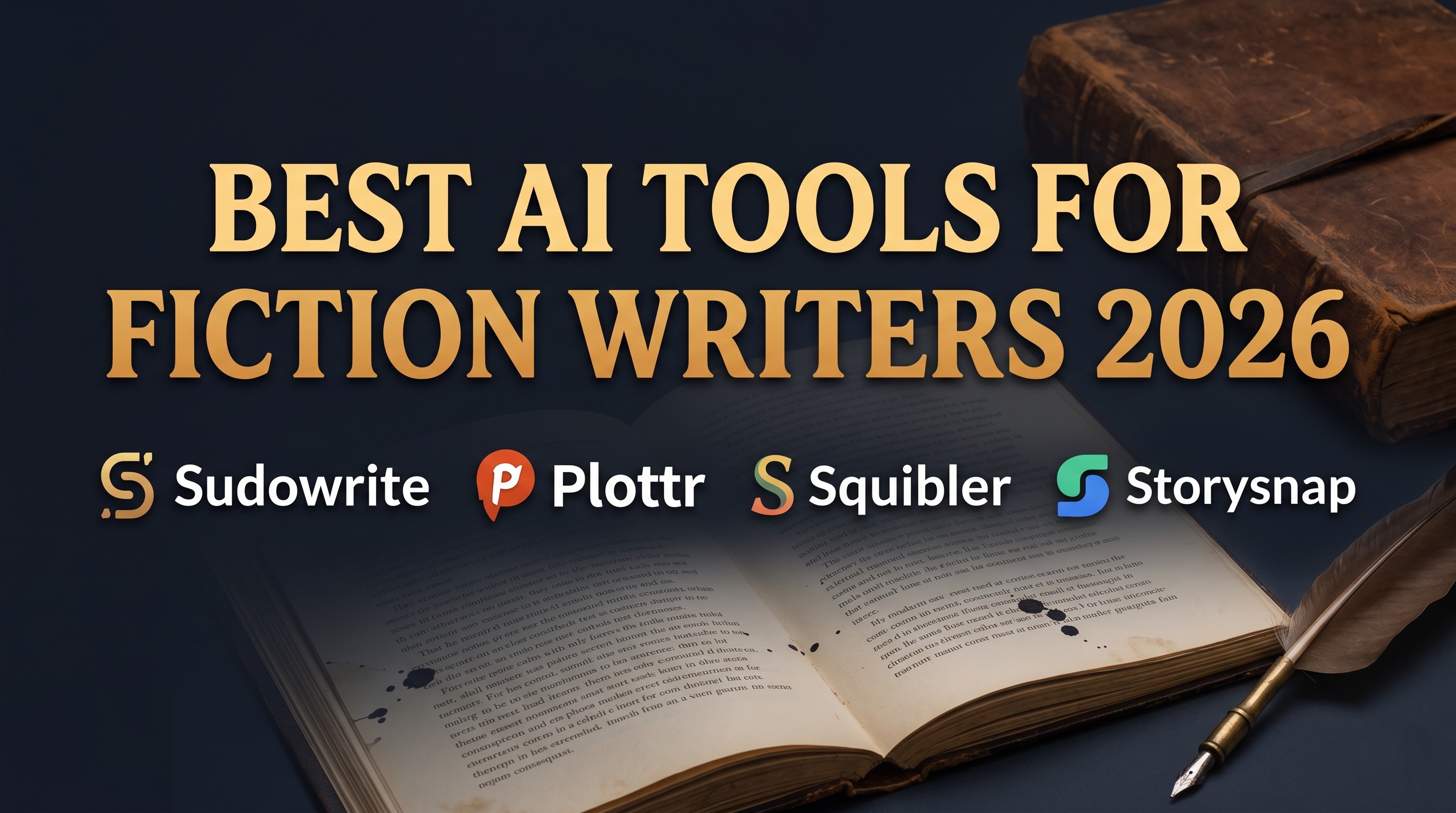
The 6 Best AI Tools for Fiction Writers in 2026 (By Stage of Writing)
The 6 Best AI Tools for Fiction Writers in 2026 (By Stage of Writing)
Writing a novel in 2026 without AI assistance is like editing a video without a timeline editor — technically possible, just significantly slower and more frustrating than it needs to be.
But the AI writing tool market is overcrowded with generalist assistants that were not built for fiction. ChatGPT forgets your characters by chapter ten. Jasper is designed for marketing copy, not narrative prose. Generic AI tools treat your dark villain, your steamy romance scene, and your morally complex anti-hero as problems to be sanitized rather than stories to be told.
This guide covers the six tools that actually work for fiction writers in 2026 — organised by the stage of writing where each one earns its subscription fee.
At a Glance: The Fiction Writer's AI Stack
| Writing Stage | The Problem | The Best Tool |
|---|---|---|
| Outlining | Organising characters, timelines, and plot structure | Plottr |
| Prose generation | Writing vivid, consistent long-form fiction | Sudowrite |
| Speed drafting | Hitting daily word counts and finishing the manuscript | Squibler |
| Series management | Building bibles for multi-book series | Storysnap |
| Brainstorming | Breaking through the blank page and plot blocks | StoryLab.ai |
| Book marketing | Writing blurbs, Amazon descriptions, and launch copy | Rytr |
1. Plottr — Structure Your Story Before You Write a Word
Best for: Plotters, series writers, anyone who needs to see the whole story before drafting
The most common reason novels never get finished is not writer's block — it is structural collapse. The writer reaches the midpoint, loses the thread, and has no map to follow back.
Plottr solves this before you write the first sentence. It is a visual story planning tool that lets you map your entire novel — plot timelines, character arcs, chapter beats, subplots — on a visual canvas. Instead of staring at a blank document wondering what happens next, you open Plottr and follow the blueprint you built.
What makes it essential:
The Timeline view shows every plot thread simultaneously — your main storyline, your romantic subplot, your villain's arc — as horizontal tracks. You can see at a glance whether your subplots are running in parallel or converging at the right moments. For multi-POV novels and series with large casts, this visual overview is invaluable.
Character Cards let you build detailed profiles — personality, motivation, backstory, physical description, relationships — before you write a single line of dialogue. When you sit down to write, your characters feel like real people because you already know them.
The template library includes pre-built structures for three-act, Hero's Journey, Save the Cat, and genre-specific frameworks. You are not inventing a structure from scratch — you are filling in a proven one.
Pricing: One-time purchase or subscription depending on the plan. Significantly more affordable than most monthly SaaS tools. Verify current pricing on the Plottr website.
Read our full Plottr review here
Transparency note: This site is reader-supported. If you click our link and make a purchase, we may earn a commission at no extra cost to you.
Start planning your novel with Plottr →
2. Sudowrite — The Prose Engine That Actually Understands Fiction
Best for: Literary fiction, genre fiction, anyone who wants their prose to sound like a human wrote it
If there is one tool on this list that serious fiction writers cannot work without in 2026, it is Sudowrite. It was built by published sci-fi authors who understood the specific frustrations of using generic AI for creative writing — and built something designed to eliminate every one of them.
What makes it essential:
The Story Bible is Sudowrite's most important feature. You input your characters, world-building rules, magic systems, locations, and genre conventions into a structured database. Every time Sudowrite generates a new scene — even if it is chapter forty — it cross-references the Story Bible. Your protagonist's eye colour stays consistent. Dead characters stay dead. Plot threads you seeded in chapter two are still intact in chapter thirty.
The Describe feature is where the prose quality becomes genuinely impressive. Highlight any noun — forest, dungeon, first kiss, crowded market — and Sudowrite generates sensory descriptions broken into sight, smell, sound, taste, and touch. You weave what works into your draft. The result is immersive, textured prose that shows rather than tells.
The Rewrite tool lets you highlight any flat paragraph and instruct the AI to make it "more tense," "more melancholic," "funnier," or "faster-paced." It rewrites with that emotional direction intact.
Crucially, Sudowrite is lenient with content filters. Dark themes, morally complex characters, gritty conflict — it handles them without interrupting your flow to lecture you about content guidelines.
Pricing:
| Plan | Price | Best for |
|---|---|---|
| Free trial | $0 | Test the Story Bible, no credit card required |
| Hobbyist | ~$19/month | Casual writers and short stories |
| Professional | ~$29/month | Most novelists — the recommended plan |
| Max | ~$59/month | Full-time authors writing multiple books per year |
Read our full Sudowrite review here
Transparency note: This site is reader-supported. If you click our link and make a purchase, we may earn a commission at no extra cost to you.
Try Sudowrite free — no credit card required →
3. Squibler — For Writers Who Need to Finish the Book
Best for: Plotters, NaNoWriMo participants, writers with deadline pressure
Sudowrite is the tool for writers who need better prose. Squibler is the tool for writers who need to actually finish.
Where Sudowrite focuses on the quality of individual scenes and sentences, Squibler focuses on the discipline of completing a manuscript. It is an all-in-one writing environment — word processor, project manager, AI generator, and publishing formatter — in a single browser-based tool.
What makes it essential:
The Smart Writer AI generates scenes directly inside your manuscript editor rather than in a separate chat window. You write a sentence, hit the AI key, and the scene continues in the same document. There is no copy-pasting between tools, no switching tabs, no losing your flow.
The daily word count tracker and goal system are designed specifically for writers who need external accountability. Set a target — 2,000 words per day for NaNoWriMo, 500 words per day for a sustainable long-term pace — and Squibler tracks your progress and reminds you when you are falling behind.
Export is one-click to PDF, EPUB, and print-ready formats. For indie authors heading straight to Kindle Direct Publishing after finishing a draft, this removes an entire production step.
Pricing: Starting at ~$16/month. Verify current pricing on Squibler's website.
Read our full Squibler review here
Transparency note: This site is reader-supported. If you click our link and make a purchase, we may earn a commission at no extra cost to you.
Try Squibler and start hitting your daily word count →
4. Storysnap — The Series Bible Builder
Best for: Prolific indie authors, series writers, developmental editors
If you write a series, you eventually face a problem no amount of willpower solves: by book three, you cannot remember what colour your protagonist's front door was in book one, whether the antagonist's name was spelled with one T or two, or which chapter revealed the location of the hidden vault.
Storysnap — built by the same team behind Plottr — solves this automatically. You upload your finished manuscript and Storysnap reads it, extracting every character, location, object, and plot point into a structured Series Bible. What would take forty hours of manual re-reading takes five minutes.
What makes it essential:
For pantsers — writers who draft without an outline — Storysnap is particularly powerful. You write your chaotic first draft, upload it to Storysnap, and receive a structured reverse outline of what you actually wrote. This is the starting point for your second draft rather than a terrifying blank page.
For developmental editors, it provides a complete structural overview of a client's manuscript in minutes — character consistency checks, plot thread tracking, location wikis — making client work dramatically faster.
Pricing: Per-manuscript pricing (~$50 per upload) rather than a monthly subscription. Bulk packages available for authors with large backlists. Verify current pricing on the Storysnap website.
Read our full Storysnap review here
Transparency note: This site is reader-supported. If you click our link and make a purchase, we may earn a commission at no extra cost to you.
Build your Series Bible with Storysnap →
5. StoryLab.ai — When You Are Stuck Before You Start
Best for: Writers with a vague idea who need a starting point
The blank page is not always about lacking words. Sometimes it is about lacking direction — you have a feeling, a character, a setting, but no story shape to hang them on.
StoryLab.ai specialises in the earliest stage of the writing process. Feed it a loose premise — "a lighthouse keeper who discovers the light is attracting something other than ships" — and it generates multiple narrative directions, character conflicts, and plot hooks. You are not getting a finished story — you are getting twenty doors to choose from.
What makes it essential:
For writers who know what kind of story they want to tell but cannot identify the central conflict that makes it work, StoryLab.ai's brainstorming output consistently generates angles that human writers would not think to consider. It is genuinely useful for breaking out of the familiar narrative patterns your brain defaults to.
It also works well mid-draft when a plot thread has collapsed and you need ten possible directions fast rather than one careful suggestion.
Pricing: Free tier available. Paid plans for heavier brainstorming volume. Verify current pricing on StoryLab.ai.
Read our full StoryLab.ai review here
Transparency note: This site is reader-supported. If you click our link and make a purchase, we may earn a commission at no extra cost to you.
Break through the blank page with StoryLab.ai →
6. Rytr — Turn Your Finished Book Into Sales
Best for: Indie authors who need to market their own work
Most fiction writers are significantly better at writing novels than writing Amazon descriptions, author bios, and email subject lines. Marketing copy requires a completely different skill — short, punchy, benefit-driven — and it is the stage where many indie authors lose sales they should have won.
Rytr is a fast AI copywriting tool built specifically for this kind of short-form persuasive writing. Paste your synopsis, select the AIDA framework (Attention, Interest, Desire, Action), and Rytr generates a compelling Amazon book description that converts browsers into buyers without spoiling the ending.
What makes it essential:
The Tone Selector is Rytr's strongest feature for authors. You can generate the same book description in "suspenseful," "warm and inviting," "humorous," or "urgent" tones and compare which one best represents your book's voice. For genre fiction where the cover, title, and description must signal genre conventions to readers immediately, this tone matching is genuinely useful.
It also handles author bios, newsletter subject lines, social media hooks for launch campaigns, and ARC (Advance Review Copy) request emails — the full suite of marketing copy a self-publishing author needs.
Pricing: Free plan available (10k characters/month). Saver plan ~$9/month. Unlimited ~$29/month.
Read our full Rytr review here
Transparency note: This site is reader-supported. If you click our link and make a purchase, we may earn a commission at no extra cost to you.
Write your book blurb and launch copy with Rytr →
The Recommended Stack by Writer Type
The discovery writer (pantser): Sudowrite + Storysnap — draft freely with AI assistance, then use Storysnap to build a reverse outline from your finished draft.
The plotter: Plottr + Sudowrite — map the entire novel before writing, then use Sudowrite's Story Engine to draft with consistency.
The speed writer: Squibler — single tool from first word to published EPUB. Add Sudowrite if prose quality becomes a priority.
The series author: Plottr (planning) + Sudowrite (drafting) + Storysnap (series bible) — the full professional stack.
The indie author ready to publish: Whatever you used to write the book + Rytr for all marketing copy.
Frequently Asked Questions
Do I need all six tools? No. Start with one that solves your current biggest bottleneck. If you cannot finish a draft, start with Squibler. If your prose feels flat, start with Sudowrite. If you cannot get started at all, try StoryLab.ai. Add tools as your writing process matures.
Will AI make my writing sound like AI? Only if you use it incorrectly. The writers who produce the best results treat these tools as co-authors — they generate raw material, you sculpt it. If you publish unedited AI output, it will sound like AI. If you use AI to break blocks and expand ideas, then edit heavily, your voice stays intact.
Can these tools handle dark themes and mature content? Sudowrite and Squibler are both significantly more lenient than general AI tools like ChatGPT. For writers of dark fantasy, gritty thrillers, or mature romance, both platforms handle complex themes without content filter interruptions.
Which tool is best for screenwriters specifically? Squibler has dedicated screenplay formatting built in. For prose generation and scene development, Sudowrite works well for scripts. Read our full Sudowrite review for details on screenplay workflows.
Are there free trials available? Yes — every tool on this list offers either a free tier or a free trial. Test before committing to any paid plan.
The Bottom Line
The best AI tools for fiction writers are not the ones with the most features — they are the ones that remove the specific obstacle between you and a finished manuscript.
Identify where your writing consistently stalls. Start with the tool that solves that specific problem. Build the rest of the stack around your process as your output grows.
Transparency note: This site is reader-supported. If you click our link and make a purchase, we may earn a commission at no extra cost to you. We only recommend tools we have genuinely reviewed.
Start with Sudowrite — the core tool for serious fiction writers →
Listings related to The 6 Best AI Tools for Fiction Writers in 2026 (By Stage of Writing)

Plottr
The #1 visual outlining tool for writers. Organize your plot, track character details, and fix plot holes before you write a single word.

Squibler
Squibler’s AI Book and Novel Writer helps you turn ideas into full novels and scripts fast, making writing easier than ever.
Sudowrite
Boost your storytelling and scriptwriting with Sudowrite AI — brainstorm ideas, refine dialogue, and structure plots with ease.
Rytr
Rytr is an AI‑writing assistant designed for creators, solopreneurs, and small teams who need fast content ideas, first drafts, or short‑form copy
Storysnap
Turn your book into viral social media posts. StorySnap uses AI to find your best quotes and creates ready-to-post videos for TikTok and Instagram.